The decision to leave Adobe Experience Manager rarely starts with technology alone. It often starts with rising licensing and operational costs, a marketing team waiting days or weeks to publish a landing page, and approval workflows that require developer involvement for routine content updates. By the time most enterprises seriously scope an AEM-to-Contentful migration, the platform is no longer the only constraint they are trying to solve. How content gets created, governed, localized, and delivered has become the larger challenge. By the time most enterprises seriously scope an AEM to Contentful migration, the platform is no longer the constraint they are trying to solve. How content gets made, governed, and shipped is.
Eight25Media is a certified Contentful partner that has led enterprise AEM migrations for organizations like Sophos and NetApp. The pattern behind every clean one is the same: the content model and localization architecture get redesigned before a single component is built. Teams that skip that step rebuild AEM inside Contentful and inherit the exact slowness they were paying to escape.
Should You Migrate from AEM to Contentful? Start With the Operating Model
AEM is not a bad platform. It is a precise one. It was built for organizations running dozens of country sites, deep localization inheritance, and centralized IT-led governance at scale. If that describes your reality, AEM earns its weight.
The challenge is that many organizations adopted AEM during an era when websites were the primary digital channel. Today’s content ecosystems often include websites, mobile applications, customer portals, commerce experiences, knowledge bases, and AI-driven experiences. Platforms designed around structured content and API delivery can be better aligned with those requirements.
The harder question is whether that describes the reality most marketing organizations actually operate in. For teams publishing across a limited number of markets, operating with marketing-led workflows, and already investing in modern front-end frameworks, AEM can introduce capabilities and operational complexity that may exceed what the business actually requires. You are paying for governance machinery you don’t use and absorbing a publishing cadence slower than your business needs. That gap, between what AEM optimizes for and what your team does day to day, is the real trigger for an AEM to Contentful migration.
The mistake is treating the choice as a feature comparison. It is an operating-model decision. Here is the honest version of where each platform fits:
| Dimension | AEM is the better fit when… | Contentful is the better fit when… |
|---|---|---|
| Market footprint | 20+ country sites with regional content inheritance | 4–8 markets where speed matters more than inheritance depth |
| Governance model | Centralized, IT-led publishing at scale | Marketing-led publishing with team autonomy |
| Localization | Heavy MSM blueprints and live-copy workflows | Locale-per-field structures designed around active markets |
| Front-end | Tightly coupled to AEM’s rendering and components | Composable: Next.js, Nuxt, React, multi-channel delivery |
| Operational load | You have a dedicated platform team to run it | You want lower overhead and faster iteration |
Most enterprises evaluating this move land on the right-hand column for the majority of those rows. That is not a knock on AEM. It is a sign the organization has changed faster than its CMS. If your portfolio genuinely spans 20-plus locales with centralized governance, staying on AEM (or moving to AEM as a Cloud Service) is the defensible call. For everyone else, Contentful’s composable architecture allows many organizations to reduce platform complexity, streamline publishing workflows, and align more closely with modern front-end and multi-channel delivery models.
Another factor increasingly influencing platform decisions is future flexibility. Organizations investing in composable architectures can adopt new front-end frameworks, commerce platforms, personalization engines, or AI tooling without tying those decisions to a single CMS vendor. For many teams, that architectural flexibility has become as important as traditional content-management capabilities.
Redesign the Content Model – Don’t Port It
The single most expensive mistake in an AEM to Contentful migration is rebuilding AEM’s page-based thinking inside a structured CMS. It shows up as content types that mirror old templates, fields tightly coupled to a specific layout, and components that exist only to recreate a page that used to live in AEM. The result is a headless platform that fails to deliver many of the operational benefits organizations expected from the migration.
Contentful rewards a different model. Content is structured, decoupled from presentation, and reused across channels. You design content types and relationships, not pages. The payoff is real: one well-modeled “Product” entry can be reused across web experiences, mobile applications, email programs, support portals, and emerging AI-powered experiences, reducing duplication and governance overhead.
Here is a fragment of how that looks in practice for a typical product-led site:
| Content Type | Key Fields | Relationships | Why It’s Structured This Way |
|---|---|---|---|
| Page | slug, SEO meta, layout (ref) | references → Section[] | Page holds routing + SEO only; no body content |
| Section | type (enum), heading, layout | references → Component[] | Sections compose pages; reorderable without dev work |
| Component | variant, copy (rich text), media | references → Asset, CTA | Reusable across pages and channels |
| Product | name, description, specs, locale fields | referenced by → Page, Email | One source of truth, many surfaces |
The design decision that matters most: keep the Page type thin. It owns routing and SEO, nothing else. Editors compose pages from reusable sections and components rather than filling in a fixed template. That is the structural difference between a Contentful build that gets faster over time and one that calcifies into AEM with extra steps.
When this model is wrong, everything downstream fights it: front-end components don’t compose cleanly, editorial workflows break, and reuse evaporates. That is why content modeling belongs in discovery, before design, rather than being figured out mid-build.
Structured content also creates advantages beyond publishing. Organizations exploring AI search, knowledge assistants, recommendation systems, and generative experiences often find that well-modeled content is significantly easier to reuse than page-centric content designed primarily for website rendering.
Localization: Rebuilding What MSM Gave You for Free
AEM provides a mature localization framework through Multi-Site Manager (MSM), including blueprints, live copies, translation workflows, and inheritance models. Contentful approaches localization differently. It provides native locale support, field-level localization, workflow capabilities, and integrations with translation-management systems, while allowing teams to design the governance model that best fits their organization. The capability exists in both platforms, but the implementation philosophy is different: AEM provides more predefined structures, while Contentful offers greater flexibility in how localization is designed and managed. The tradeoff is that Contentful gives teams more flexibility in how localization is structured, which also means those decisions need to be made deliberately during discovery rather than inherited from the platform.
Teams that miss this distinction discover it the hard way around month three, when content duplication explodes and regional governance quietly breaks down. “Contentful handles localization” is true in capability and false in practice until someone designs it.
A working locale architecture for a mid-footprint enterprise looks like this:
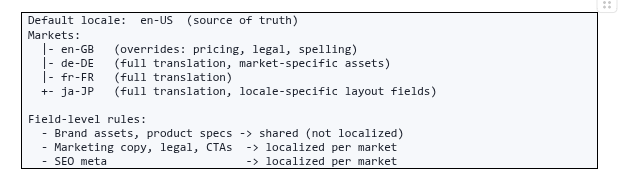
For Sophos, Eight25 delivered a headless implementation spanning 9 locales, and the locale model was settled in discovery rather than negotiated mid-build. The lesson generalizes: decide what is shared versus localized at the field level before modeling, define content ownership by region, and pick your translation workflow up front. Defer it and localization becomes a mid-project crisis instead of a design decision.
Scope the Real Inventory Before You Design Anything
What a project brief calls “5,000 pages” is almost never 5,000 pages. It becomes 12,000-plus once you count locale variants, PDFs that search engines treat as pages, undocumented microsites from old campaigns, and legacy content nobody audited. Scope discovered mid-build arrives as change orders, not as insight.
Before any design work, build a command-center inventory: a complete page and asset classification that makes scope knowable while it still matters. A usable audit structure looks like this:
| Field | Example | Purpose |
|---|---|---|
| url | /products/firewall/xg-series | Canonical source path |
| type | product / landing / blog / PDF | Drives content-type mapping |
| locale | en-US, de-DE | Surfaces hidden variant count |
| action | migrate / consolidate / archive / redirect | Decision per item, made once |
| owner | Product Marketing | Accountability for sign-off |
The action column is where the savings live. A large share of legacy AEM content should be archived or consolidated rather than migrated, and deciding that up front shrinks the build instead of dragging dead weight into a clean platform. Most vendors skip this step because it forces a harder conversation early. It is also the difference between a knowable budget and a surprising one.
The Migration Mechanics: Moving Content Without Breaking It
API access and a CLI are table stakes. The work that separates a clean AEM to Contentful migration from a messy one is in the edge cases generic agencies wave past.
Rich text and embedded components. AEM’s rich text is full of embedded experience fragments, inline CTAs, and interactive widgets. Dumping that into Contentful’s rich text field as raw markup is how you lose reusability. Each embedded type needs a migration decision:
| Source (AEM) | Migration approach | Target (Contentful) |
|---|---|---|
| Experience fragment | Extract to its own entry | Referenced block in rich text |
| Inline CTA | Convert to structured component | Embedded entry block |
| Interactive widget | Strip and rebuild | Component reference + front-end module |
Broken reference repair. AEM content is dense with internal links and DAM asset references that break on migration. Automate a reference audit ([page_id | broken_ref_type | source_url | resolution]) rather than discovering dead links in production.
URL and SEO equity. Map every legacy URL to its destination with explicit redirect handling for language prefixes, query parameters, and media paths. A redirect table ([old_url | new_url | http_status | notes]) is the cheapest insurance you can buy against an organic-traffic cliff.
Version history. Decide deliberately: full preservation (expensive, audit-grade), archive-and-simplify (most common), or clean start. Defaulting to “migrate everything” because no one made the call is how storage cost and complexity sneak back in.
Budget, Timeline, and Governance for an AEM to Contentful Migration
Budget for content like it’s a second project, because it is. Audit, cleanup, mapping, restructuring, and QA routinely rival or exceed build effort. Healthy projects run closer to 60% build / 40% content; troubled ones invert to 40/60. Initial budgets that assume 80/20 are the ones that blow up.
A realistic phased shape for a mid-footprint enterprise migration:
- Discovery (3–4 weeks): content model, locale architecture, command-center inventory, governance blueprint
- Foundation: content types, locale setup, integration scaffolding, core templates
- Core migration: [VERIFY: high-priority page count] priority pages, automated where structure allows
- Long tail + archive: secondary content, redirects, consolidation
- Training + handoff: editor enablement, documentation, post-launch support window
Governance is not a launch-week task. Design it in discovery and validate it in staging:
| Role | Permissions | Environment Access |
|---|---|---|
| Editor | Create, draft | Dev only |
| Reviewer | Review, approve | Dev + staging |
| Brand/Region Manager | Approve for market | All environments |
| Publisher | Deploy to production | Production |
The biggest risk on these projects is rarely technical. It is internal: decision delays on the content model, stakeholder misalignment on taxonomy, and no single accountable owner on the client side. Contentful removes a great deal of operational weight, but it does not make organizational decisions for you. That part stays human.
Frequently Asked Questions
How long does an AEM to Contentful migration take?
For a mid-footprint enterprise, roughly 5,000–15,000 pages across several locales, plan for a migration effort measured in multiple months rather than weeks. The exact timeline depends more on content complexity, localization requirements, and stakeholder alignment than on platform implementation alone. The variable that moves the timeline most is not the build; it is how quickly the organization settles content model and taxonomy decisions in discovery. Teams with a single accountable owner finish meaningfully faster than committee-driven ones.
Is Contentful a true replacement for AEM?
For most marketing-led organizations operating across a handful of markets, yes, and usually a faster, lighter one. The exception is enterprises running 20-plus country sites with deep MSM-based inheritance and centralized IT governance; that profile leans on capabilities AEM provides natively and Contentful expects you to architect. Match the platform to your operating model, not to a feature checklist.
What’s the most common reason these migrations go over budget?
Underestimating content. The platform work is predictable; the content audit, cleanup, restructuring, and localization design are where unscoped effort hides. The second most common reason is treating localization as a setting rather than a system that has to be designed.
How do I choose a good Contentful migration partner?
Look for a partner who insists on designing the content model and localization architecture before building, who runs a real discovery phase instead of treating unknowns as “figure it out later,” and who can show enterprise localization experience specifically. Eight25Media is a certified Contentful partner that works content-model-first for exactly this reason: it’s the step that determines whether the platform gets faster or slower after launch.
Should we move to AEM as a Cloud Service instead?
If your organization genuinely needs AEM’s localization depth and centralized governance, AEM as a Cloud Service is the lower-risk path and worth serious evaluation. If the renewal pain is really about speed, autonomy, and cost for a smaller market footprint, that’s a signal the operating model has outgrown AEM, and a composable platform like Contentful fits the direction better.
What are the tradeoffs of moving from AEM to Contentful?
Contentful typically reduces platform complexity and provides greater flexibility for composable architectures, but organizations should understand the tradeoffs. Features such as localization inheritance, site management, and governance that are deeply embedded in AEM may require additional design decisions, integrations, or operational processes in Contentful. The goal is not to replicate AEM feature-for-feature, but to determine whether a composable approach better supports the organization’s future operating model.
Planning an AEM to Contentful Migration?
If your team is seriously evaluating a move off AEM, the most valuable thing you can do before requesting RFP responses is get a clear-eyed scoping conversation: one that maps the real content inventory, the localization architecture, and the operating-model shift before a dollar is committed. That’s the work most vendors defer until you’re already in contract, and it’s where the budget surprises come from. At Eight25Media, we run that discovery first, so you walk into the build knowing the actual scope.