
Introduction
A few months ago, I spoke with a VP of Marketing at a fast-growing SaaS company. Her team was gearing up for a major product launch—one that had the potential to define their year. They had already invested in PR, social campaigns, and paid ads. All that was left was updating the website to spotlight the new product.
That’s when the problems began.
Every small change—uploading translations, adjusting layouts, setting up redirects—required developer tickets. Marketing couldn’t publish without waiting days for engineering support. Their global teams were left frustrated, sending spreadsheets of content that sat in backlogs.
By the time the product pages went live, it was three weeks too late. Competitors had already announced their launches. The VP admitted: “It felt like we missed the window, not because of our strategy, but because our CMS just couldn’t keep up.”
This is the hidden cost of outdated platforms. They don’t just slow down publishing—they slow down business. Opportunities slip away. Teams lose confidence. And the website, instead of being an enabler of growth, becomes the bottleneck that holds it back.
That’s why so many enterprises look to migrate to Contentful. But here’s the catch: migration isn’t just about moving content from point A to point B. If you carry over the same broken models, unclear workflows, or patchwork governance, you’ll recreate the same bottlenecks in a new system.
The real problem isn’t just where your content lives—it’s whether the move sets you up to scale without friction.
That’s why choosing the right Contentful migration agency matters. The partner you pick determines whether migration is a painful one-off project—or the foundation for long-term digital agility.
This guide will walk you through everything you need to know about selecting the right agency, including what pitfalls to avoid, what criteria to use, and how to ensure your investment pays off.
Why Choosing the Right Contentful Migration Agency Matters
Business Context for Enterprise Organizations
For large enterprises, websites aren’t marketing side projects—they’re mission-critical assets. Whether you’re in SaaS, finance, or healthcare, your website is the first impression, the validation point, and often the deciding factor for prospects.
Migrating to Contentful promises:
- Faster publishing workflows
- Omnichannel content distribution
- Improved scalability for global sites
- Stronger developer + marketer collaboration
But without the right migration partner, those promises can fall apart.
Why a Contentful Migration Agency Matters
Migrating to Contentful isn’t just a technical lift. Without the right partner, enterprises often repeat the same mistakes that caused bottlenecks in the first place. A strong migration agency helps you avoid pitfalls that cost time, revenue, and trust.
Here’s what can go wrong—and why the right agency makes all the difference:
| Pitfall | Why It Happens | Impact if Ignored |
|---|---|---|
| Operational bottlenecks | Content models are copied “as is” from legacy CMS, keeping editors dependent on developers. | Marketing still waits on engineering for basic updates. Campaigns miss windows of opportunity, slowing revenue growth. |
| Data loss & SEO drops | Redirects, metadata, and structured data aren’t mapped during migration. | Organic traffic plummets. High-value pages lose ranking, and competitors capture your audience. |
| Cost overruns | Scopes aren’t well-defined; agencies underestimate complexity of integrations and data cleansing. | Budgets balloon mid-project, delaying ROI and causing tension between marketing and IT. |
| Fragmented governance | No clear rules for roles, permissions, and workflows. | Content becomes chaotic. Editors create inconsistencies, brand credibility erodes, and security risks increase. |
| Short-term “lift and shift” thinking | Migration focuses only on moving pages, not redesigning models for scale. | The CMS becomes just another bottleneck, forcing a second rebuild in 12–18 months. |
A dedicated Contentful migration agency doesn’t just “move content.” They anticipate these pitfalls, bring frameworks and automation to reduce risk, and ensure the migration creates long-term scalability rather than short-term fixes.
How to Choose the Right Contentful Migration Agency
Since this is a vendor comparison opportunity, let’s structure it as key evaluation criteria (each with examples, insights, and what to watch for).
1. Experience with Enterprise-Grade Migrations
Not all agencies are created equal. Many claim CMS migration expertise—but haven’t handled the complexity of multi-region, multi-language enterprise sites.
What to look for:
- Proven track record with migrations specifically (not just generic CMS work).
- Case studies showing successful enterprise-scale projects.
- Ability to handle complex integrations (CRM, DAM, analytics, personalization engines).
2. Technical Depth vs. Strategic Guidance
Migration isn’t just “lifting and shifting” content. It’s rethinking your architecture for flexibility.
Technical Depth vs. Strategic Guidance in Contentful Migration
| Dimension | Technical Depth Example | Strategic Guidance Example | Why Both Matter |
|---|---|---|---|
| Content Modeling | Agency builds 20+ content types exactly mirroring the old CMS, ensuring a 1:1 migration. | Agency challenges the need for 20 content types, consolidates into 8 scalable models, enabling faster publishing. | Without strategy, you copy old problems into a new system. Without technical skill, you can’t execute scalable models. |
| SEO Preservation | Agency sets up automated scripts for 5,000 redirects and validates metadata during migration. | Agency audits content to identify which pages shouldn’t be migrated (low traffic, outdated), streamlining the SEO footprint. | Technical ensures no rankings drop. Strategic ensures you don’t migrate “junk content” that drags down performance. |
| Integration | Engineers configure Contentful to sync with Salesforce, HubSpot, and GA4. | Strategists advise which integrations are business-critical vs. “nice to have” for phase one. | Technical execution keeps systems connected. Strategic prioritization prevents scope creep and cost overruns. |
| Governance | Developers configure permissions: admin, editor, author roles in Contentful. | Strategists define workflows (e.g., content draft → legal review → publish), ensuring governance scales across global teams. | Technical sets up roles; strategy defines how those roles support business processes. |
| QA & Testing | Engineers run automated QA to detect broken links, missing assets, or template issues. | Strategists run user journey QA to ensure experiences (e.g., campaign flow or checkout path) make sense. | Technical catches errors; strategy ensures usability and business outcomes aren’t compromised. |
| Change Management | Engineers deliver a working CMS and handoff documentation. | Strategists run role-based training workshops, onboarding marketers and editors to use Contentful effectively. | Technical delivery without adoption = wasted investment. Strategic training ensures ROI. |
3. Migration Methodology & Tooling
Agencies should bring more than manpower—they should bring repeatable systems.
Methodology to Assess a Contentful Migration Agency
| Assessment Area | What to Look For |
|---|---|
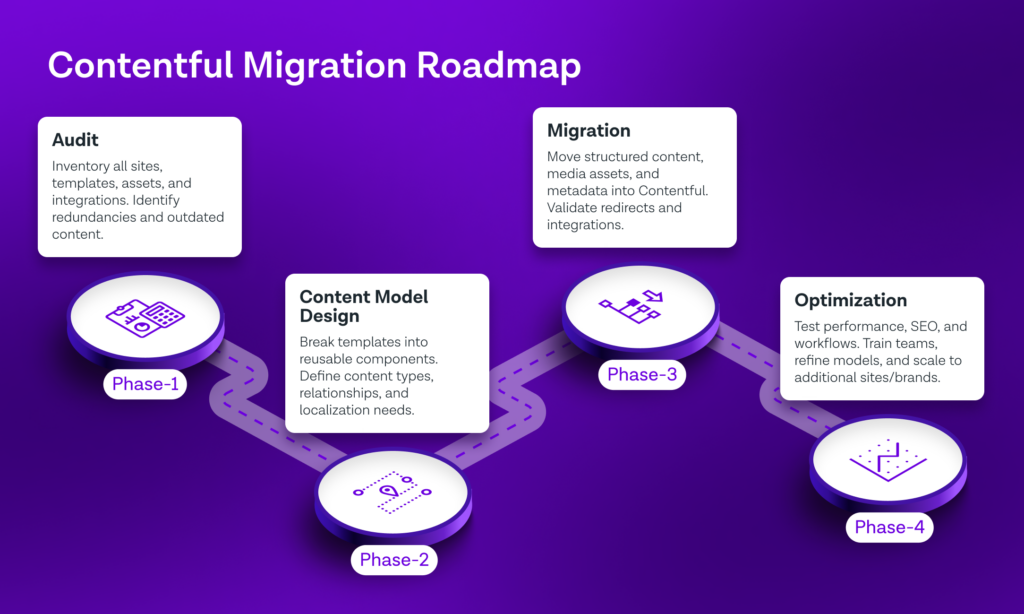
| Framework & Process | Clear, repeatable methodology broken into phases (Discovery → Architecture → Migration → QA → Training → Support). |
| Tooling & Automation | Use of migration scripts, API connectors, and automated QA tools (not just manual work). |
| SEO & Redirect Handling | Pre/post SEO audits, automated redirect mapping, metadata preservation. |
| Roadmap & Timeline | A visualized roadmap with milestones, dependencies, and risks called out. |
| Pilot / Proof of Concept | Small-scale test migration to validate quality before full rollout. |
4. Integration & Ecosystem Expertise
- Contentful only delivers full value when it integrates seamlessly with the rest of your digital ecosystem. Here’s how it plays out across stacks, teams, and business outcomes:
| Integration | Example Stack | Impact if Mishandled |
|---|---|---|
| CRM | HubSpot, Salesforce | Leads don’t sync correctly, creating duplicate records or missing attribution. Sales loses visibility into campaign-driven pipeline. |
| Analytics | GA4, Segment, Amplitude | Pageviews and conversions break during migration. Leadership can’t trust dashboards, slowing decision-making. |
| Personalization Engines | Optimizely, Dynamic Yield, Adobe Target | Personalized content fails to display or reverts to defaults. Customer journeys feel generic, reducing engagement and conversions. |
| E-commerce Platforms | Shopify Plus, BigCommerce, custom cart | Product data isn’t synced. Pricing errors or broken carts disrupt transactions, directly hitting revenue. |
| DAM (Digital Asset Management) | Bynder, Cloudinary | Broken asset links lead to missing images, inconsistent brand visuals, and frustrated designers recreating assets manually. |
| Marketing Automation | Marketo, Pardot, Eloqua | Nurture campaigns stop triggering. Prospects drop out of the funnel, reducing pipeline velocity. |
5. Change Management & Training
Key Questions to Ask a Contentful Migration Agency
| Category | Questions to Cover |
|---|---|
| Training & Enablement |
|
| Documentation & Playbooks |
|
| Governance & Workflow Design |
|
| Post-Migration Adoption & Support |
|
| Change Management |
|
6. Pricing Transparency & Engagement Models
Contentful Migration Agency Pricing Models Compared
| Pricing Model | How It Works | Best Fit For |
|---|---|---|
| Fixed Fee | Agency sets a single upfront price for the entire migration project. | Enterprises with well-defined scopes and minimal expected changes |
| Time & Materials | Billed hourly/daily for actual time spent, plus costs of tools/resources. | Complex migrations with uncertain requirements or evolving content models |
| Phased Retainers | Monthly/quarterly fee covering migration, training, and post-launch support. | Enterprises planning multi-phase rollouts (global sites, integrations, long adoption period) |
Actionable Takeaways
Checklist for choosing the right Contentful migration agency:
- Validate enterprise Contentful experience
- Ask about migration methodology & automation tools
- Ensure integration expertise across your martech stack
- Demand governance frameworks & training support
- Pick a pricing model that best fits your requirements
10 Reasons Why eight25 Is a Top Pick for Contentful Migration
When enterprises look for a Contentful migration agency, they’re not just buying technical help—they’re looking for a partner who can reduce risk, move fast, and unlock long-term business value. Here’s why Eight25 stands out as a top choice:
1. Proven Track Record with Enterprises
eight25 has delivered successful migrations for global enterprise brands. We understand the complexity of multi-language sites, regulatory requirements, and large-scale content ecosystems.
2. Content Modeling Expertise That Scales
We don’t just “lift and shift” old templates into Contentful. Our strategists design lean, scalable content models that empower marketing teams while avoiding future rebuilds.
3. SEO-First Migration Approach
SEO traffic is one of your most valuable digital assets. We protect it with automated redirect maps, structured data checks, and metadata preservation—so you don’t lose rankings or visibility post-migration.
4. Automation + Efficiency
Our engineering team brings proprietary scripts and frameworks that automate bulk migration. This reduces errors, accelerates timelines, and saves months of manual work.
5. Deep Integration Expertise
Contentful doesn’t live in isolation. eight25 ensures seamless integration with Salesforce, HubSpot, Segment, and your DAM—so marketing, sales, and product data flow smoothly across the stack.
6. Governance & Workflow Frameworks
We help enterprises avoid post-migration “content chaos” by establishing clear roles, permissions, and workflows. This governance ensures speed without sacrificing brand consistency or compliance.
7. Training & Adoption Programs
We don’t leave you with a new CMS and a manual. eight25 delivers, documentation, and ongoing enablement so your marketers, editors, and developers all succeed from day one.
8. Enterprise-Grade QA & Risk Mitigation
We run comprehensive QA across all pages, templates, and integrations. From redirect testing to broken link detection, we anticipate issues before they go live.
9. Transparent Pricing & Phased Approach
eight25 scopes migrations into clear phases—discovery, execution, QA, training, and support—so costs are predictable and aligned to outcomes. No hidden fees, no ballooning budgets.
10. Future-Proof Digital Foundation
We see migration as more than a one-time project. eight25 builds reusable components, scalable content models, and governance structures that prepare your digital ecosystem for years of growth.