
CMS Migration Security: The Access Controls That Only Exist Mid-Project
The platform cleared your security review in March. The vendor’s SOC 2 report is in the file, the residency question was settled before contract, and the architecture diagram is approved. Then month three of the migration arrives and your estate looks like this: two content platforms live at once, a service account with write access to both, eleven contractors holding editor logins, and a staging site carrying a full copy of production content.
None of that was in the security review, because the review assessed the destination rather than the transition. CMS migration security is a separate control problem with temporary identities, environments, integrations, and owners that disappear once the project ends. That matters particularly in headless migrations, where the CMS, frontend, CDN, APIs, preview environments, and supporting services create more explicit security boundaries to manage. eight25 is a Contentstack Preferred Partner and Contentful Silver Solution Partner, and on enterprise migrations we treat access provisioning as a tracked workstream so every temporary grant has an owner, scope, and path to revocation.
Why CMS Migration Security Reviews Miss the Middle
A vendor risk assessment usually focuses on two relatively stable states: the platform you have and the platform you are buying. Both have documented control sets, established owners, and known operating procedures. The migration creates a third, temporary state that can last for months and is often only partially covered by either platform’s steady-state security model.
Headless architecture does not eliminate that transitional risk, but it can make the boundaries easier to define. Content APIs, environments, preview services, deployment infrastructure, and frontend hosting can be isolated and credentialed separately rather than inheriting one broad CMS permission model. The security advantage comes from using those boundaries deliberately separate environments, scoped tokens, short-lived credentials, and independent revocation rather than treating the headless stack as one system.
| Control question | Before migration | During migration | After migration |
|---|---|---|---|
| Platforms holding live content | One | Two | One |
| Who can write to production | Named internal editors | Editors, migration service accounts, partner engineers | Named internal editors |
| Where a full content copy sits | Production | Production, staging, tooling in transit | Production |
| Who owns credential revocation | Internal IAM, via HR leaver process | Ambiguous: grants are project-scoped, not employment-scoped | Internal IAM |
That fourth row concentrates the risk. Enterprise identity governance is built around employment events: someone joins, someone leaves, the directory reflects it. Migration access follows project phases instead, and no HR system emits a signal when a content-load sprint ends.
The Five Access Surfaces That Exist Only During a Migration
The temporary access created around a migration clusters into five recurring surfaces. They appear at different points some before contract, others during environment setup, content load, QA, or cutover and most should disappear once the work that required them is complete. The risk is that project access is often provisioned quickly under schedule pressure and never revisited with the same urgency.
| Access surface | What holds it | Scope it usually gets | Scope it needs |
|---|---|---|---|
| Migration service account | Migration scripts and tooling | Admin on source and target | Read-only on source, scoped write on target environment only |
| Temporary human grants | Partner engineers, contractors, QA | Copy of an existing editor or admin role | Per-environment role, expiring at phase end |
| Staging environment | Project team, reviewers, preview users | Shared password, deployment URL, or weak perimeter control | Identity-based access restricted to authorized users, enforced by the platform or edge layer |
| Preview and draft routes | Anyone who guesses the path | Unauthenticated, sharing production cache | Separate route and cache from production reads |
| The presales crawl | The agency, pre-contract | Covered by an NDA only | Covered by a data processing agreement |
The migration service account is the highest-privilege identity in the project
A content migration usually needs broad read access to the portion of the source estate being migrated and substantial write access to the target environment. The quickest implementation is often a broadly privileged account or token on both systems, but that creates a machine identity capable of reading large portions of the legacy estate while modifying the new one exactly the kind of cross-platform privilege that should be narrowed rather than accepted as a migration default.
Split the identity and apply least privilege to each side. The source credential normally needs read and export permissions only; the target credential needs write access only to the environment being populated. Modern headless platforms make this separation easier because APIs, environments, and delivery contexts can be credentialed independently. Where the platform supports scoped or expiring credentials, use them, and rotate migration credentials between major phases rather than allowing one broadly privileged token to survive from kickoff through launch.
Temporary human grants peak exactly when nobody is watching
Content load and QA often combine high delivery headcount with significant schedule pressure, which is exactly when temporary access accumulates fastest. On a delivery model with rotating engineers or contractors, someone leaving a workstream without their access being revoked is an easy way to create an orphaned grant. That is cheap to prevent with named accounts, expiry dates, and a defined deprovisioning clock and much more expensive to discover months after launch.
Three access requests should stop the conversation until someone explains the specific task behind them:
- Broad or persistent write access to the production CMS. Most migration work should happen through read-only source access and scoped target environments; any production write requirement should be tied to a specific cutover task, owner, and time window.
- Admin access to analytics or adjacent platforms where a scoped read or service role will satisfy the requirement.
- A shared account of any kind. Named individual or attributable machine identities are what make auditing and revocation possible.
Staging holds production content with none of production’s controls
Usually not as a standing permission. A migration partner normally needs read or export access to the source platform and scoped write access to the target environment. Some cutover or synchronization activities can legitimately require temporary production write access, but that should be the exception: tied to a defined task, narrowly scoped, time-boxed, logged, and revoked once the task is complete. A partner asking for broad production write access for the duration of the migration should be able to explain exactly why it is necessary.
The CMS does not have to be the only enforcement point. During eight25’s NetApp migration from Tridion to Contentstack, staging protection was enforced at the edge as part of the delivery architecture rather than relying solely on the CMS. Contentstack now also supports identity-based authentication for Launch environments, illustrating how quickly platform capabilities evolve. The durable principle is architectural: if a required control is not available in one layer, enforce it in another CMS, hosting platform, CDN, WAF, or identity provider rather than weakening the requirement.
The fifth surface, the presales crawl, is a contract problem, covered below.
What Actually Goes Wrong: Orphaned Grants and Unmanaged Machine Identities
The migration-specific failure is not always an incident during the project. Often the more durable problem is what survives it: service accounts, tokens, external users, and integrations that remain active after the people who created them have moved on. By the time they are discovered, the delivery context that explained why they existed may be gone too.
Orchid Security’s Identity Gap: 2026 Snapshot, published in May 2026, found that 67% of non-human accounts in its analysis were established inside applications and remained outside centralized IAM visibility; it also reported that 40% of accounts were orphaned. Separate research from the Cloud Security Alliance and Oasis Security found that 78% of surveyed organizations lacked documented, formally adopted policies for creating or removing AI identities. The datasets measure different populations, but they point to the same governance problem: machine and application identities are being created faster than many organizations can centrally inventory, govern, and retire them.
A CMS migration is a concentrated machine-identity event. Service accounts, API tokens, webhook secrets, deployment credentials, preview tokens, and integration keys can be created across the CMS and the surrounding delivery stack within a short period. In a headless architecture that may include the CMS, frontend host, CDN, search, analytics, DAM, translation platform, and CI/CD tooling. Unless those identities are deliberately inventoried, some will sit outside the organization’s normal joiner-mover-leaver and IAM processes the same governance gap highlighted by the Orchid research.
Access provisioning can also become a material schedule risk on enterprise migrations, especially when credentials span multiple systems and owners. On NetApp’s migration, per-system credential regimes across privileged-access tooling, the enterprise identity platform, and the translation platform were described by the delivery team as gotchas coming out of the woodwork. The response was structural: dedicated sessions with the owner of each system rather than chasing provisioning inside a weekly status call. Every credential had an owner and a lead time, and both had to be established before they became blockers.
The Controls That Close the Window
Five controls address most of the migration-specific access problem without requiring a new security platform. The access register provides the operating backbone; the remaining controls make its entries easier to constrain, attribute, and retire.
1. A migration access register. One row per grant, written the moment the grant is made. This is the artifact that turns revocation from an investigation into a checklist:
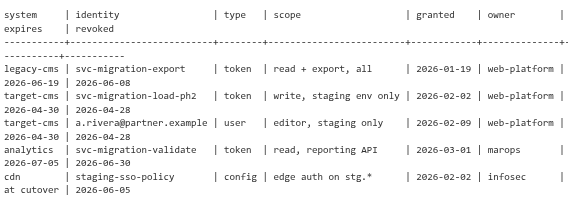
Of the eight columns, expires is the one that changes the operating model, and it should be filled in when access is granted rather than reconstructed at handover. A grant issued without an expiry condition is effectively standing access until someone remembers to revisit it.
2. Grants time-boxed to a phase. Content load, QA, and cutover need different access. Issue one credential set for the whole engagement and the broadest scope any single phase needed stays live for all of them.
3. Edge-enforced authentication on staging. Hold staging to the same authentication standard as production. If the CMS cannot enforce it, the CDN or WAF can.
4. Named accounts only, with no exceptions for speed. A shared login destroys attribution, and attribution is what makes the register meaningful.
5. Data terms that cover the crawl when the crawl involves protected data. Discovery sometimes starts before the main statement of work, and the contractual boundary should match the data the partner can actually access. A crawl of public marketing pages is different from receiving authenticated exports, user data, form records, private documents, or other personal or confidential content. Where the partner will process personal data on the client’s behalf, put the applicable data-processing terms in place before that access begins, including appropriate sub-processor disclosure and deletion obligations. The contract should follow the data boundary, not the procurement calendar.
Where CMS Migration Security Belongs in the Project Plan
Provisioning belongs on the plan as its own workstream, with a named owner and a lead time per system, sitting alongside content modeling and integrations.
| System | Credential type | Owner | Illustrative enterprise lead time | Blocks |
|---|---|---|---|---|
| Privileged-access tooling | Vault-issued credentials | InfoSec | 2–4 weeks | Any integration touching internal systems |
| Enterprise identity platform | SSO app registration, SCIM | IAM | 2–3 weeks | Partner engineer onboarding |
| Translation platform | Enterprise seat + connector auth | Localization | 2–4 weeks | Locale content load |
| CDN / WAF | Config access, staging auth policy | Infrastructure | 1–2 weeks | Staging environment security |
| Analytics and search | Scoped read roles | MarOps | 1–2 weeks | Migration validation |
Treat the lead times as illustrative. The pattern holds: every row has a different owner in a different part of the organization, and none of them report to the project. On a five-month migration, a three-week provisioning lead time discovered in month three is a schedule event, which makes front-loading this a delivery decision before it is a security one.
This machinery is also overhead, and there is a size below which it is not worth building. If your content layer holds only public marketing material and one internal admin can run the migration alone, a formal register and phase-scoped tokens cost more in coordination than they return. Named accounts and an authenticated staging environment are worth it at any size. The rest starts earning its keep once external parties and multiple environments are in play.
Over-application fails as often as under-application. A control set written for the system holding customer records, applied to the system holding marketing copy, produces a plan nobody can execute and leaves the team on a legacy estate less secure than the platform they were trying to reach.
When to Keep the Migration In-House Instead
Some migrations require a different operating boundary for sensitive content. The deciding factor is not simply whether an external partner is involved, but what data that partner needs to access and which controls govern that access.
Where the content layer contains regulated records, customer information, health or financial data, residency-restricted material, or similarly sensitive datasets, the migration should be designed so unnecessary exposure is removed. That may mean client-controlled exports, masked or scrubbed datasets, restricted migration utilities, dedicated environments, or having the internal team retain custody of the highest-sensitivity systems. A capable implementation partner can still own the architecture, content model, frontend, integrations, and migration process without requiring unrestricted access to every underlying record.
When the estate is primarily marketing and product content, an experienced external migration partner can operate safely inside a much simpler boundary: named accounts, least-privilege access, protected staging, documented machine identities, and a defined deprovisioning process. The question should not be internal versus external by default; it should be which delivery model gives every credential a clear owner, scope, purpose, and expiry.
A third pattern splits the difference. On NetApp’s migration, the client’s own developers ran their own repositories and hosting environments for the areas they owned, submitting pull requests into the delivery team’s staging branch. Internal capability gets built during delivery, not after handoff, and the highest-sensitivity areas stay under internal control without stalling the rest of the migration.
Frequently Asked Questions
What security controls do we need during a CMS migration, not just after?
Five controls cover the transitional window: a migration access register with an expiry date filled in at grant time, credentials time-boxed to a phase instead of the whole project, edge-enforced authentication on any staging environment holding production content, named individual accounts with no shared logins, and data processing terms that cover the presales crawl. A migration is a third control state, governed by neither your current platform’s documentation nor your new platform’s security review.
Should a CMS migration partner get write access to our production CMS?
No. A migration needs read and export access on the source platform and scoped write access to one environment on the target. Staging access plus a read-only production export covers every legitimate migration need, so a partner requesting production write access is asking for more than the work requires. Ask which specific task needs it.
How do we secure a staging site that holds a copy of our production content?
Use identity-based access appropriate to the sensitivity of the staging content. If staging contains unpublished, embargoed, or otherwise non-public material, do not rely on an obscure URL or broadly shared password. Modern headless stacks give you several enforcement points: the CMS or preview platform may provide environment authentication directly, while the hosting layer, CDN, WAF, or identity provider can add another boundary where required. The important point is that preview convenience should not determine the security model.
What happens to a migration partner’s access when the project ends?
Settle it in the contract before kickoff. Handover is too late to negotiate it. Ask for a deprovisioning SLA with a defined clock, and ask what happens to access when an individual rotates off the delivery team mid-project, which is the most likely source of an orphaned grant. If every grant gets logged in a register as it is issued, revocation at handover becomes a checklist instead of a forensic exercise.
Can our implementation partner own migration access control, or should our own IAM team?
Your organization should retain policy and revocation authority, whether that sits with IAM, InfoSec, platform engineering, or another designated owner. The implementation partner should track every grant it requests or creates and reconcile that inventory before handover. On eight25 enterprise migrations, provisioning is treated as a delivery workstream for exactly this reason: the migration team has the best view of which temporary identities the project created, while the client needs that information transferred into its long-term governance process before the project ends.
Planning a Migration That Has to Survive Its Own Middle Phase?
Most security conversations about a CMS migration happen at the two ends: clearing the platform before contract, and passing the pre-launch review. The months in between get scoped as a project-management concern, which is where orphaned credentials come from. At eight25, provisioning is a tracked workstream from day one, with an owner and a lead time per system, because the discipline that keeps credentials accounted for is the same discipline that keeps a three-week provisioning delay from becoming a scheduled event.
If your team is scoping a migration now, the useful conversation is which access it will genuinely need, who approves it, and when each grant expires.