Contentful vs Contentstack for Enterprise: An Honest 2026 Assessment
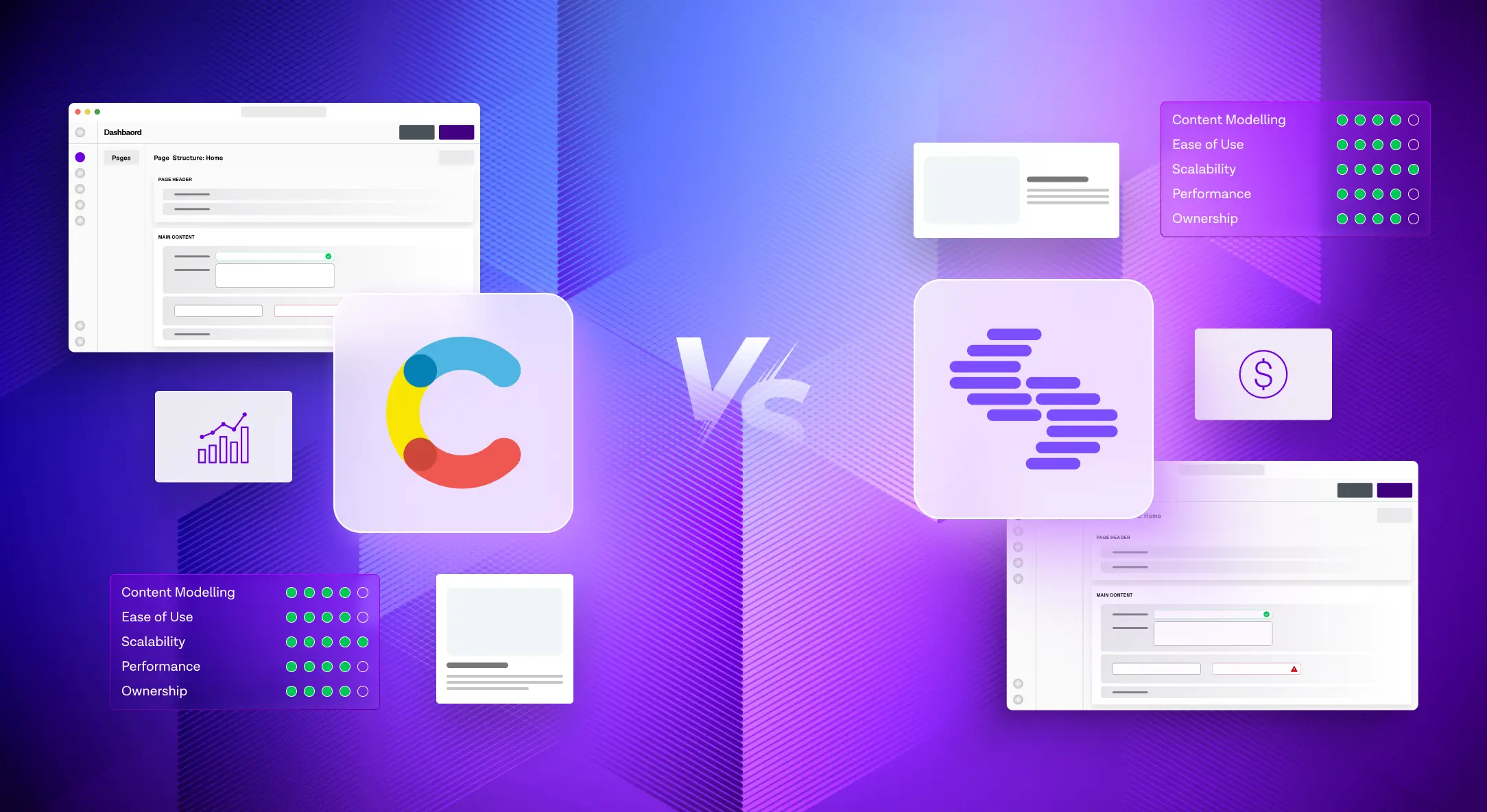
The short answer: neither platform is universally better. The right choice depends on how your team plans, governs, builds, and publishes content every day. Contentful often fits enterprises that want a highly composable content foundation with strong developer control and flexible modeling patterns. Contentstack often fits enterprises with large editorial teams that need governed publishing, structured workflows, and marketer-friendly operations out of the box. Both are mature enterprise headless CMS platforms in 2026. If your evaluation spreadsheet says one platform wins on features alone, the spreadsheet is probably measuring the wrong thing.
eight25 works with both. As of July 2026, we’re listed as a Silver-tier Contentful partner and a Preferred Contentstack partner, and we’ve delivered enterprise-scale work across both ecosystems, including Qlik on Contentful and Contentstack implementations for large B2B and enterprise teams. That matters for one reason: we make money implementing either platform, so the assessment below is not steering you toward the one product we happen to sell. It is the same read we would give a VP across the table before a dollar of budget was committed.
Here’s how this headless CMS comparison actually breaks down for an enterprise buyer.
The Decision That Matters More Than Features
Your team has sat through four CMS demos in two weeks. Every vendor showed a polished editing interface, a clean API, and a slide about “enterprise-grade scalability,” and both Contentful and Contentstack checked most of the same boxes. That’s normal, and it’s why feature matrices don’t predict platform fit: the differences that decide success surface during implementation, not during sales. The predictor that actually holds up is your team profile: whether your content operation is developer-led or editor-led.
| Dimension | Contentful | Contentstack |
|---|---|---|
| Content modeling | Field-level localization, flexible references, composable by design | Modular blocks, built-in global fields, entry-level localization |
| Editorial experience | Powerful, but needs customization for non-technical editors | Stronger out-of-box editorial UX with built-in live preview |
| Workflow & governance | Basic workflow, extensible via apps and webhooks | Built-in release management, workflow engine, approval chains |
| Developer experience | API-first design, extensive SDK ecosystem, larger community | Solid APIs, focused enterprise connectors, built-in asset management |
| Localization | Field-level: granular control, per-field fallback | Entry-level: structured, workflow-driven per locale |
| Pricing model | Entry-based, can escalate at scale | More predictable negotiated enterprise licensing |
| Ecosystem | Larger community, more third-party integrations | Smaller but focused enterprise partner ecosystem |
Neither platform wins across every row. If one did, this comparison wouldn’t need to exist.
Content Modeling: Two Genuinely Different Approaches
How each platform structures content and handles localization shapes everything downstream: editorial workflows, developer architecture, and multi-market scaling.
Contentful uses field-level localization. A single “Product Page” entry holds fields like title, description, and cta_text, and each field localizes independently. The English and German versions of title live on the same entry. A field that doesn’t need translation (a part number, say) falls back to the default locale automatically.
Contentstack commonly treats localization at the entry level. When an entry is localized, it becomes an independent localized version with its own versioning and publishing queue status. That makes it easier for locale teams to move at different speeds: the German version can sit in editorial review while the English version is already live.
| Scenario | Contentful strength | Contentstack strength |
|---|---|---|
| 20+ locales with selective translation | Field-level control reduces duplication | Per-locale workflow states and approval chains |
| Locale-specific publishing schedules | Needs custom scheduling work | Built-in per-locale scheduling and release management |
| Shared assets across locales | Reference-based single source of truth | Built-in global fields simplify shared content |
In our Qlik work, where the move from Sitecore XP to Contentful centered on speed, reuse, and a scalable content foundation, Contentful’s modeling flexibility was the right fit for a content operation with strong technical ownership and heavy reuse across markets. In large Contentstack migrations such as NetApp, where distributed editorial teams manage high-volume, multi-locale publishing, Contentstack’s localized entry model and workflow-oriented operating model can better match how the organization actually publishes: locale teams moving at their own pace, each with its own review and release needs.
The rule of thumb: if your content operation is developer-led, Contentful’s composability is the stronger fit. If your editors manage 10-plus locales on different publishing schedules, Contentstack’s per-locale workflow engine earns its keep fast.
Editorial Experience: Where the Daily Reality Diverges
A demo-friendly editing interface and a production-ready editing experience are different things. Contentful’s editorial experience is powerful and increasingly mature, with live preview, Launch, scheduled publishing, release calendars, workflow states, and a large app ecosystem. It still tends to work best when the content model is carefully designed and editors are trained around structured content. Contentstack also offers a strong first-party editorial experience, including live preview, visual editing capabilities, workflows, releases, scheduling, and governance patterns that many large editorial teams find easier to adopt out of the box. The difference is less “Contentful has weak editorial tooling” and more “Contentful gives teams more architectural flexibility, while Contentstack often gives editorial operations more of the governed publishing experience upfront.”
The deciding factor is your editorial team’s technical comfort. If your editors are comfortable with structured content and can navigate a developer-oriented interface with training, Contentful’s extensibility buys long-term flexibility. If your editorial team is large, non-technical, and needs to publish without leaning on developers, Contentstack shortens time-to-self-sufficiency from months to weeks.
| Capability | Contentful | Contentstack |
|---|---|---|
| Live preview | Custom implementation via preview API | Built-in, configurable per content type |
| Content scheduling | API-based, needs custom UI or third-party app | Built-in scheduling with calendar view |
| Rich text editing | Flexible, requires field-level configuration | Structured, with built-in embedded components |
One concrete example of what “editorial experience” means in dollars: on NetApp, publishing a PDF used to take 30 to 40 minutes of manual work in the old Tridion CMS. In Contentstack it became a simple upload, with metadata auto-pulled from the Bynder DAM. That kind of daily-workflow saving compounds across a large editorial team, and it never shows up on a feature checklist.
Governance, Workflows, and Enterprise Controls
For compliance-heavy industries (financial services, healthcare, higher education, cybersecurity), governance architecture is often the deciding dimension. The question isn’t whether either platform can support governance. It’s how much you build versus how much ships ready to configure.
Contentful supports governance through roles and permissions, workflows, scheduled publishing, Launch, release calendars, and the ability to extend processes through apps, APIs, and webhooks. It can support sophisticated enterprise governance, but the final shape often depends on plan selection, configuration, content model design, and how much the team wants to tailor the editorial operating model. Contentstack also ships strong governance primitives, including workflows, releases, scheduling, audit logs, and role-based controls, with a product experience that often feels more directly aligned to large editorial operations from the start.
Contentstack ships a built-in workflow engine with configurable stages, role-based approvals, and release management that bundles entries into a release and deploys them together. Environment promotion from development to staging to production is a first-class feature, not an API exercise.
| Governance need | Contentful approach | Contentstack approach |
|---|---|---|
| Multi-step approval | Custom via App Framework or webhooks | Built-in configurable workflow stages |
| Release bundling | Manual or API-driven publishing | Native release management with bundled deploys |
| Environment promotion | Environment aliases, managed via API | Built-in dev → staging → production flow |
| Audit trail | API-based change tracking | Built-in audit log with user attribution |
If your organization requires multi-stage approval, auditability, and coordinated releases before anything reaches production, both platforms can support that operating model. Contentstack often gets teams there faster when the desired process closely matches its native workflow, release, and audit-log patterns. Contentful can also support enterprise governance through workflows, Launch, scheduled publishing, roles, permissions, and extensibility, but teams should validate during discovery whether the desired approval model is mostly configuration or requires additional implementation. On complex Contentstack migrations such as Sophos, the workflow and release model can do real operational work by helping one editorial organization govern a consolidated site without hand-building the entire approval system first.
Integration and Developer Ecosystem: Another Read on Team Fit
This is the same developer-led vs editor-led question seen from the engineering side. Contentful’s developer ecosystem is larger: more SDKs, more community libraries, more Stack Overflow answers, more open-source starters. For engineering teams weighing long-term maintainability and hiring, that depth matters.
Contentstack’s integration focus is often attractive to enterprises that want more of the editorial, asset, workflow, and martech operating model assembled inside one vendor ecosystem. Its marketplace, asset capabilities, and enterprise connector story can reduce integration work for teams running a mature composable stack. Contentful’s ecosystem is broader and more developer-extensible, with a large marketplace, strong app framework, and many third-party and technology partner integrations. The right question is not “which platform integrates?” Both do. The better question is whether your team wants a broader developer-led integration ecosystem or a more tightly packaged editorial and enterprise operations layer.
The API philosophies differ too. Contentful has a long-standing API-first model with distinct delivery, preview, and management patterns that many engineering teams already know well. Contentstack also offers REST and GraphQL options with an enterprise CMS model that keeps content management, workflow, release, and delivery concerns closely connected. In practice, the better fit depends on how your engineering team wants to structure delivery, preview, deployment, and editorial operations across the stack.
Pricing and Total Cost of Ownership
Contentful pricing is usage- and plan-dependent. The variables that matter typically include users, roles, locales, API calls, CDN bandwidth, spaces, enterprise features, and any add-ons or premium capabilities. At enterprise scale, with many spaces, locales, workflows, integrations, and high delivery volume, costs can climb in ways that are not always obvious during early budgeting. One offset is that field-level localization can reduce entry duplication for some multilingual models, but pricing should be validated against the actual content model and usage forecast rather than assumed from entry count alone.
Contentstack pricing is also plan- and quote-dependent, especially at enterprise scale. In practice, it is often evaluated through negotiated packages that account for capabilities, environments, workflows, users, and broader platform needs. For large editorial organizations, that can make forecasting easier when capacity and governance needs are clearly defined upfront, but buyers should still model total usage, integrations, support, and add-ons before assuming predictability.
Either way, keep the license in proportion. In eight25’s enterprise migration experience, platform licensing is only one part of total cost of ownership. Implementation, content modeling, migration, training, integrations, governance design, and ongoing operations often represent the larger investment. For a mid-complexity enterprise deployment involving multiple brands, several integrations, and real content migration, implementation can run into the mid-to-high six figures. A $50K difference in annual licensing matters far less than a three-month delay caused by choosing a platform that fights your team’s operating model.
Where eight25 Fits
We’re a Silver-tier Contentful partner and a Preferred Contentstack partner, and the work we do reflects both relationships. On Contentful, that includes content modeling, implementation, ongoing content services, and technology solution consulting. On Contentstack, that includes design services, cloud migration, business and technical strategy and advisory, and managed services. Because we deliver on both platforms, the recommendation should come out of discovery: your content model, integrations, editorial workflow, governance requirements, localization model, and operating team. The goal is not to prove one platform is better. It is to identify which platform is better for your organization.
Frequently Asked Questions
How do I choose between Contentful and Contentstack for my enterprise?
There’s no single best headless CMS for enterprise; the right one starts with your team profile, operating model, and governance needs, not a feature matrix. If you have a strong engineering team building a composable experience across channels, Contentful’s flexible architecture, modeling options, ecosystem, and extensibility may fit better. If you have a large editorial team with complex publishing workflows, compliance requirements, and a need for editors to work independently quickly, Contentstack’s workflow-oriented editorial experience may be the better fit. Either way, let the decision follow a structured discovery sprint that maps your content model, integrations, localization model, editorial workflow, and governance requirements before you commit budget.
What’s the difference between field-level and entry-level localization?
Field-level localization, commonly used in Contentful, stores multiple locale versions of a field within one entry and can use fallback rules when a localized value is missing. Contentful also supports other localization strategies, including entry-level localization, depending on how the content model is designed. Contentstack commonly localizes entries so that a localized entry becomes independent, with its own versioning and publishing queue status. Field-level localization can be compact and developer-friendly; entry-level localization can be more intuitive for editors managing locale-specific publishing schedules and approval flows.
Is eight25 biased toward one platform?
No, and the reason is structural. We’re a Silver-tier Contentful partner and a Preferred Contentstack partner, with enterprise experience across both ecosystems. We earn revenue implementing either platform, so our recommendation comes from discovery findings rather than from steering you toward the only product we sell. Ask any prospective partner whether they have shipped enterprise work on both platforms, and ask how they would decide between them for your content model, integrations, localization needs, and governance requirements. A partner with experience on only one platform may still be capable, but they should be transparent about that lens.
How much does it cost to implement Contentful or Contentstack at enterprise scale?
Platform licensing varies with content volume, seats, and API usage, but it’s usually only 20 to 30 percent of total cost. The larger investment is implementation: for a mid-complexity enterprise deployment with multi-brand requirements, five or more integrations, and content migration, plan for the mid-to-high six figures. The costs that catch teams off guard are content model redesign, legacy content migration, and editorial training, not the license itself.
Planning a Headless CMS Evaluation?
The most valuable step before committing to either platform is a structured discovery engagement that maps your content model, editorial workflows, integrations, and governance needs against both Contentful and Contentstack. We run this as a focused discovery sprint that produces an architecture recommendation with honest trade-offs documented before a dollar goes to implementation.