
Headless CMS CRM Integration: Connecting Your Site to Marketing Automation
The quarterly channel report is usually where it surfaces. Nearly every new contact from the last three months is attributed to direct traffic, on a site that is measurably working – traffic up, page speed good, forms submitting without a single error in the logs. Sales asks which campaigns produced the pipeline. Nobody can answer, because the records arrived with no history attached to them.
Headless CMS CRM integration tends to fail at the seams, not inside the individual systems. A headless architecture makes those seams explicit: the CMS defines the content and form schema, the front end owns the experience, and the CRM or marketing automation platform owns the customer record. For durable, business-critical forms, that usually means designing a controlled submission layer that validates payloads, preserves the visitor identity and attribution data the destination platform supports, applies spam controls, and routes data to the systems that need it. The exact submission pattern still depends on the marketing platform. eight25 designs those integration boundaries as part of enterprise headless implementations across platforms including Contentful and Contentstack, with work for organizations such as NetApp and Sophos.
Three Layers That Used to Be One
In a traditional DXP such as Sitecore or AEM, much more of the form lifecycle can sit behind one platform boundary: rendering, field configuration, validation, and integration logic may be managed as part of the same implementation. Headless makes those boundaries more explicit. The form experience lives in the front-end application, its editable schema may live in the CMS, and the resulting lead belongs in the CRM or marketing automation platform. That separation gives teams more freedom, but it also means somebody has to own the contracts between the three.
| Layer | Where it lives | Who owns it | What breaks when nobody owns the seam |
|---|---|---|---|
| Markup and submit behavior | Front-end app (Next.js, Nuxt, Astro) | Front-end engineering | Tracking identity dropped from the payload; vendor endpoint exposed in client JavaScript |
| Question schema and copy | Headless CMS | Marketing / content ops | Editors add questions with no destination field; values post and vanish |
| Lead record and automation | CRM / marketing automation platform | MarOps / sales ops | Records arrive unattributed; routing and scoring fire on incomplete data |
Read that table as three correct pieces of work: front-end engineering shipped a fast, accessible form, content ops modeled the questions marketing asked for, MarOps built the routing rules. Every team passes its own test, and the failure lives in the two seams between them, where no statement of work puts a name.
Worth separating from the migration version of this problem. During a replatform, integrations fail because a system is being replaced underneath them, which is a different failure with a different fix. [INTERNAL LINK: Integrations Through a CMS Migration – analytics, search, DAM, CRM, consent, and personalization]. What follows is the architecture that has to work every day afterward.
Why Every Lead Says “Direct Traffic”
Nothing logs an error when this happens, which is why it survives for quarters and why it is the most expensive failure in the category.
The Cookie the Payload Forgot
HubSpot and Marketo both support associating a form submission with the anonymous visitor identity created by their tracking scripts. In HubSpot, the hubspotutk cookie can be passed as context.hutk on a Forms API submission. Marketo’s current Submit Form API can accept the visitor’s Munchkin cookie through its cookie member. If that identity is omitted, the lead can still be created, but the marketing platform may not be able to connect the newly known person cleanly to the anonymous browsing history that preceded the conversion.
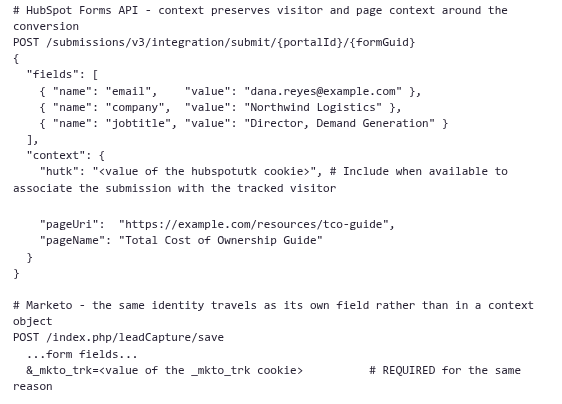
The easy implementation mistake is to test only for record creation. A developer posts the fields, receives a successful response, sees the person appear in the destination system, and closes the ticket. But record creation and marketing attribution are different acceptance criteria. In HubSpot, for example, custom website conversions should generally use the Forms submission contract when form context and visitor association matter rather than treating the interaction as a generic CRM contact creation. The implementation should be tested for the resulting activity history and attribution data, not merely for the existence of the record.
Treat visitor identity as a first-class integration field whenever consent and the destination platform make it available. Code review should verify that the submission preserves that identity rather than accidentally dropping it. When the value is legitimately absent because the visitor has not consented or no tracking identity exists, the submission should still follow the site’s consent policy instead of inventing one. The standard is preservation when available, not attribution at any cost.
Tracking That Fires Once
Traditional analytics and marketing tracking implementations commonly initialize on the initial page load. In a single-page application, subsequent route changes do not automatically behave like full browser navigations, so the integration needs to tell the marketing platform when the route changes. Without that SPA-specific tracking, a visitor can browse several virtual pages while the marketing platform records far less navigation history than actually occurred.
Marketo exposes the escape hatch: Munchkin.munchkinFunction(‘visitWebPage’, { url: document.location.href }), wired to the router’s route-change event so every client-side navigation logs a visit. Three lines of code, almost never in the original build ticket, because whoever writes the ticket is thinking about rendering and whoever needs the data is in a different meeting.
The behavioral scoring model does not break. It under-counts, which is worse, because it presents as an audience that reads one page and leaves – and teams respond by rewriting content that was working.
What Consent Legitimately Takes From You
Better plumbing narrows the attribution gap; it cannot eliminate it. A consent configuration may prevent marketing tracking from being set at all, and browser privacy controls can also limit the persistence or usefulness of some client-side identifiers. In those cases, a technically correct submission may legitimately arrive without a marketing identity. The goal is therefore not 100% attribution recovery. It is to distinguish attribution lost because the integration dropped available data from attribution that was never available under the user’s consent and browser conditions.
So separate the two numbers that usually get reported as one: identity you lost to a bug, and identity you never had because the visitor declined. Instrument the first, report the second as a known floor, and stop treating a structural limit as a performance failure.
Client-Side, Server-Side, or Both
Every engineer who finds a vendor endpoint sitting in browser JavaScript wants to move it server-side. That instinct is correct about security and wrong about Marketo.
| Pattern | What it does well | What it costs | When to choose it |
|---|---|---|---|
| Vendor embedded form | Inherits validation, spam controls, progressive profiling, and attribution for free | Limited design control; third-party iframe inside your layout | Short-lived campaign microsites, a single gated asset, loose design constraints |
| Client-side background submit | Fires the platform’s native form-fill activity; carries the tracking cookie without extra work | Endpoint and form IDs visible in client code; validation is yours to build | Marketo, where Smart Campaign triggers listen for the form-fill event |
| Server-side submission service | One owner for validation, identity, spam controls, retry, and fan-out to multiple systems | Code the enterprise now maintains; vendor browser features must be rebuilt | Durable, high-volume paths feeding routing or scoring the business depends on |
Marketo deserves its own implementation decision because not every lead-creation endpoint behaves like a form submission. The important distinction is no longer simply “browser versus REST”; it is whether the chosen API creates the activity and associations the existing Marketo programs depend on. Marketo’s current Submit Form REST endpoint is specifically designed to behave like a form submission: it can create a Fill Out Form activity, validate form fields, associate the lead with a program or campaign, and accept the visitor’s Munchkin cookie. A generic lead upsert is not equivalent. Before choosing a submission pattern, inventory the Smart Campaign triggers already in production and test the exact endpoint against them.
The mature pattern is therefore not automatically hybrid. It is the smallest architecture that preserves the marketing behavior the business actually uses. For some Marketo implementations, the Submit Form REST API plus a controlled server-side integration layer can preserve the required form activity and visitor association. Other implementations may retain a browser-side Forms 2.0 path because of existing scripts or business logic. The decision should come from testing the current campaigns, attribution requirements, consent model, spam controls, and integration destinations – not from a blanket preference for client-side or server-side submission.
Sometimes the correct answer is the embed. A webinar registration page with a six-week lifespan and no design constraint does not justify a submission service – you would build, test, and maintain infrastructure to replace something that already works, then owe yourself the progressive profiling and spam handling you had been getting free. The pattern here earns its cost on durable paths: demand-gen forms on the main site, gated content at scale, anything feeding a model the business makes decisions with.
Which platform sits on the other end matters more than any architectural preference:
| Platform | How visitor identity attaches | Honest verdict for a headless front end |
|---|---|---|
| Salesforce Web-to-Lead | No marketing identity, no deduplication | Weakest option. Creates records indiscriminately with any validation built by you. Avoid it when a marketing automation platform is present. |
| HubSpot Forms API | context.hutk, read from the hubspotutk cookie | Strongest fit. Documented contract, honest about what the token does. Use Forms, never Contacts. |
| Marketo Forms 2.0 / REST | _mkto_trk cookie value, plus Munchkin association | Client-side background submit as default, REST as fallback. Trigger behavior decides, not preference. |
| Pardot form handler | Handler receives your posted data; Pardot cookie set on the visitor | The correct headless pattern – your markup, your styling, handler takes a copy. Prefer it to the iframe form. |
In the integration architecture sessions we run before front-end build starts, that table is the first artifact on the wall. Choosing a submission pattern by principle instead of per platform is how a capable team spends a quarter fighting its own marketing automation platform.
The Form Is a Content Type With a Contract
Here is the failure MarOps directors describe most often, and it never reaches a bug tracker. An editor adds a question to a form.
They add “Company size,” because a new routing rule needs it to send enterprise inquiries to a different sales queue. The question renders. Visitors answer it. The value posts to the marketing automation platform, finds no field it maps to, and vanishes without an error. The form works. The routing rule never fires. Two weeks later there are three people on a call about it, one of them from the CRM vendor, and the form is the last place anybody looks.
Nothing about that sequence is preventable in the front end, which is why the question itself has to carry its destination:
| Question attribute | Type | Who can change it | Effect on the CRM |
|---|---|---|---|
| Label, help text, order, required flag | Text / integer / boolean | Editor, no approval needed | None – presentation only |
| CRM field name (Company_Size__c) | Short text, validated against the live field list | MarOps, via change request | Determines where the value lands |
| Allowed values | List, validated against the CRM picklist | MarOps, via change request | A value outside the picklist fails at publish instead of dropping at submit |
That boundary does the actual work: editors own what the visitor sees, while MarOps owns how those values map into the marketing and CRM systems. Mapping errors should be caught as early as possible – ideally before content is published – while the submission layer still validates every live request. If a question references no destination field, or a field that no longer exists in the approved mapping, the CMS workflow should block or flag the change before launch. Runtime validation then protects the integration from malformed requests, drift, and traffic that bypasses the front end.
We produce that mapping as a discovery artifact: every question, its destination API field, and its allowed values, pulled from the live CRM rather than a spreadsheet somebody exported last quarter. Field lists drift, and a mapping checked against a stale export will fail in production.
This slows editors down, which is the deliberate trade. A team that could previously add a question in ten minutes now files a request, and gets back a form where every question has a destination and nothing disappears quietly. MarOps directors take that deal immediately. Content teams need to hear the reason once.
The Same Rule, Applied to Gated Content
Keep submissions, lead state, and customer records out of the CMS unless there is a deliberate business reason to store them there. A headless CMS is primarily the content system of record; the CRM, marketing automation platform, or customer-data layer should normally own lead and customer state. Duplicating personal data into the CMS creates another surface that must participate in retention, access, deletion, and governance processes. The cleaner headless boundary is to let the CMS describe the experience while customer systems own the customer.
The same boundary governs personalization. Audience membership belongs in the customer data platform or the decisioning layer, with the CMS holding content variants keyed to segment IDs; encode the segments themselves as CMS entries and you get a taxonomy nobody can audit, versioned as content rather than as rules. Editors then need preview that runs the real decisioning path, because a preview rendering something other than what ships is a guess with a URL on it. The counter-case: four segments with no fifth planned does not justify buying a customer data platform, and front-end rules keyed to a query parameter or an account lookup will handle it.
What Breaks in Month Six, and Who Owns It
Everything above is build-time. The failures that cost real money arrive after the project team has rolled off and nobody is watching this path.
| What fails | How it presents | What to monitor |
|---|---|---|
| Schema drift | A question stops reaching the CRM after a content or CRM change | Nightly diff of CMS field mappings against the live CRM field list |
| Endpoint scraping | Bot submissions post straight to your handler, triggering scoring and sales alerts | Submission rate by source; honeypot hit rate; challenge failure rate |
| Consent regression | Volume normal, tracking identity arriving empty | Share of submissions carrying a non-empty hutk or _mkto_trk |
| API quota exhaustion | Late-day submissions fail silently after other integrations drain the daily quota | Quota consumption per integration; dead-letter queue depth |
| Duplicate webhook processing / sync-loop amplification | The same webhook is processed twice, or a bidirectional integration keeps generating new updates across systems. | Deduplicate Contentful webhook deliveries with X-Contentful-Idempotency-Key; separately monitor update frequency, recursion/loop guards, and repeated writes between the CMS and downstream systems. |
One of the highest-value controls on that list is a scheduled synthetic lead: a test submission sent through the real user path into a clearly flagged test record, with alerts if the submission fails or expected attribution data disappears. The implementation effort varies by stack, but the operating principle is simple – test the business outcome continuously instead of waiting for a quarterly attribution report to reveal that the integration has been broken for weeks.
Spam earns its own note because any publicly reachable form endpoint should be treated as discoverable and directly callable. A layered defense can combine lightweight bot signals such as a honeypot with a challenge system such as Cloudflare Turnstile and, critically, server-side validation before the submission is trusted or forwarded downstream. The server must validate the challenge token and the payload because requests do not have to originate from your front end at all.
Then name the owner. Not simply “engineering” or “marketing,” but a named person accountable for the integration from architecture through handover and post-launch operation. That ownership matters even more on the kind of large enterprise CMS programs eight25 delivers for organizations such as NetApp and Sophos, where content, front-end engineering, marketing operations, analytics, and platform teams all touch the same customer journey. Technical seams are much easier to manage when responsibility for them is explicit before the build starts.
Long-term ownership often should not sit entirely with the agency. A healthier model is for the enterprise to own its customer-data and marketing operations while a partner such as eight25 remains accountable for the headless platform and the integration architecture it helped design. The important part is that the handover is designed during discovery rather than discovered after launch. That reduces dependency without abandoning the architectural context needed to evolve the platform safely. [INTERNAL LINK: eight25 headless CMS implementation services]
Frequently Asked Questions
How do you integrate a headless CMS with a CRM and marketing automation platform?
For durable enterprise forms, a common headless pattern is to introduce a controlled submission layer between the front end and the downstream customer systems. That layer can validate the payload, preserve the visitor identity supported by the destination platform, enforce spam and security controls, and route data to the CRM or marketing automation system. The CMS owns the editable form schema and content, the customer platform owns the resulting record, and the integration layer owns the contract between them. The exact submission path still depends on the platform: HubSpot, Marketo Engage, and Salesforce Account Engagement do not expose identical form and identity models.
The test is not whether the form submits, because it will, but whether the record arrives with its source attribution intact.
Why are all the leads from my headless website showing as direct traffic?
A missing visitor identity is one common cause, but it is not the only one. For HubSpot, a custom Forms API submission can include the hubspotutk value as context.hutk; Marketo’s Submit Form API can associate the person with the visitor’s Munchkin cookie. Omitting those values can prevent the platform from cleanly connecting the known lead to earlier anonymous activity. Attribution can also be degraded by consent choices, browser privacy controls, missing campaign parameters, incorrect analytics configuration, or SPA route changes that are not reported to the tracking platform. Diagnose the identity and event chain rather than assuming every “direct” lead has the same cause.
Should form submissions from a headless site go client-side or server-side?
It depends on the platform and the business behavior you need to preserve. Server-side processing gives you a controlled place for validation, spam protection, retries, enrichment, secrets, and fan-out. Browser-side submission can still be useful when a platform’s client SDK or existing implementation provides behavior you rely on. Marketo’s current Submit Form REST API complicates the old “client-side for form events, REST for records” rule because it can itself create a Fill Out Form activity and associate the Munchkin cookie. The right answer is therefore to test the specific submission contract against your attribution and automation requirements. For a short-lived campaign with simple requirements, the vendor’s embedded form may still be the most economical option.
How do you keep Marketo Munchkin or HubSpot tracking working in a Next.js app?
Call the tracking function manually on every client-side route change. Both scripts bind on page load, so in a single-page app a visitor who reads six pages generates one page view. For Marketo, hook the router’s route-change event and call Munchkin.munchkinFunction(‘visitWebPage’, { url: document.location.href }); For HubSpot, use HubSpot’s SPA/page-view tracking mechanism on route changes rather than assuming the initial tracking-script load will represent every virtual navigation. Skip it and behavioral scoring under-counts rather than failing, which makes it hard to spot: engaged visitors look like single-page bounces.
Who should own martech integrations on a headless website build?
A named person on the delivery team, from architecture through at least the second quarter after launch, with the CRM field mapping and the submission service as their explicit deliverables. Integrations fail when they sit between “marketing’s problem” and “the vendor’s thing” and belong to nobody until something is visibly wrong. eight25 scopes the submission service and the field-level CRM mapping as discovery artifacts with an owner attached, then designs the handover, usually to MarOps with agency support retained for the platform layer, instead of leaving ownership for someone to discover later.
Planning a Headless Build With a Marketing Stack Behind It?
Before the front end gets built, map what already exists: the forms in production, the fields they populate, the visitor identity that accompanies them, the campaigns and workflows they trigger, and the teams that own each dependency. eight25 starts there rather than with an abstract architecture diagram, because a technically elegant headless integration that changes the marketing behavior already running in production is still a failed migration. The acceptance test is not simply whether the form submits. It is whether the right record arrives, the expected attribution survives, the required automation fires, and somebody owns the path after launch. If you are planning a headless build – or operating one where attribution has stopped making sense – that conversation belongs in discovery, before more code gets written.