How eight25 Helped Qlik Preserve SEO Value With Seamless Migration
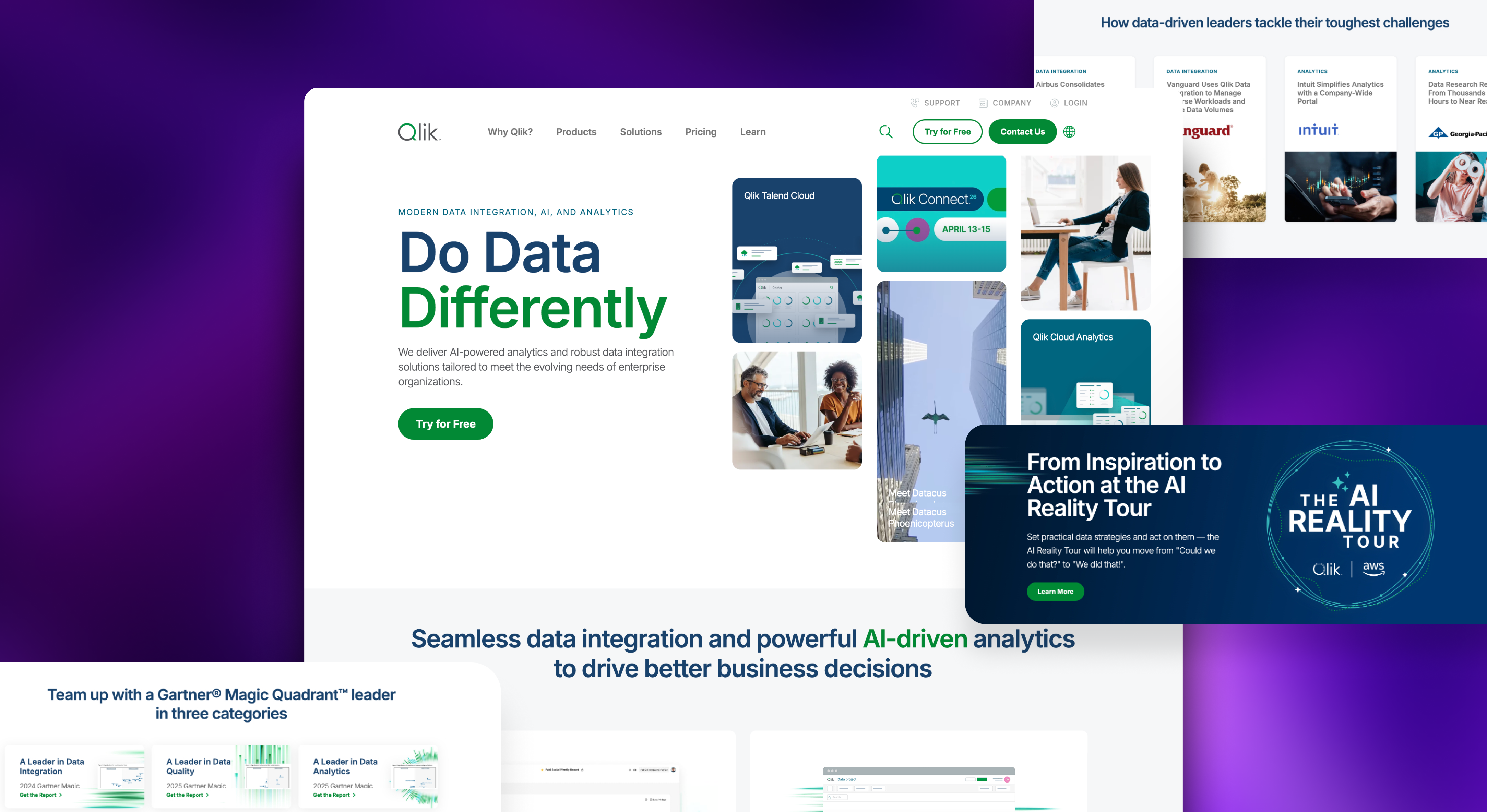
When Qlik, a global leader in data integration and analytics, acquired Talend, the vision was bold: unify two powerful platforms under a single brand. The challenge? Migrating a high-traffic enterprise website like Talend.com into Qlik.com without losing years of SEO equity, hard-earned search rankings, and a steady flow of qualified leads.
Website migrations at this scale are never just technical checkboxes. They’re strategic, high-stakes moves that touch every part of the business from digital pipeline health to customer trust and brand perception. A poorly executed migration can cost millions in lost traffic, disrupt lead flow, and damage reputation.
Qlik turned to eight25 with the goal of protecting Talend’s SEO value, guiding customers through a seamless experience, and building a stronger digital foundation for growth.
The Challenge: High Stakes, High Complexity
1. Traffic at Risk
Talend.com had already seen sharp organic traffic declines since April. A rushed migration could accelerate that downward trend, jeopardizing visibility and conversion flow.
2. Complex Brand Transition
Customers were still actively researching and buying through Talend.com. Redirecting everything too quickly risked confusing prospects, undermining trust, and creating friction during a sensitive acquisition phase.
3. Limited Internal Bandwidth
Qlik’s digital and SEO teams were stretched thin. With leadership pushing for speed and results, the internal resources weren’t enough to manage an enterprise-scale migration without introducing risk.
The Solution: A Phased SEO Migration Strategy
Qlik partnered with eight25Media to design and execute a phased, data-driven migration strategy tailored for enterprise websites. The approach balanced urgency with precision, ensuring no critical SEO value slipped through the cracks.
Step 1: Building the Baseline
We started with a comprehensive technical and SEO audit of Talend.com:
- Identified high-value pages and URLs generating the bulk of organic traffic.
- Mapped backlink profiles to preserve external authority signals.
- Prioritized keywords where Talend ranked competitively.
- Benchmarked current traffic, conversions, and rankings to measure post-migration performance.
This baseline became the roadmap for everything that followed.
Step 2: Phased Redirect Rollout
Instead of a one-size-fits-all redirect approach, we implemented a staged migration:
- Phase 1: High-priority content (product pages, solution pages, key blogs) migrated first with monitored 301 redirects.
- Phase 2: Secondary assets (support content, gated resources, older blogs) transitioned once stability was confirmed.
- Phase 3: Legacy or low-value pages decommissioned strategically.
This reduced disruption, maintained visibility, and gave the team time to adapt as data came in.
Step 3: Customer-Centric Navigation
Beyond redirects, we worked with Qlik’s digital team to restructure navigation pathways. The goal was to make sure Talend’s existing buyers could still find the information they relied on, now under the Qlik brand, without friction or confusion.
Step 4: SEO Guardrails and Monitoring
To avoid blind spots, we:
- Established a clear escalation plan for any red flags in performance
- Implemented QA testing for every redirect.
- Set up real-time analytics dashboards to monitor traffic, rankings, and conversion paths.
Timeline: What a Realistic Enterprise Migration Looks Like
For enterprise companies, expectations often clash with reality. A successful SEO migration doesn’t happen in a week. Here’s what a realistic timeline looks like, based on Qlik’s phased approach:
- Month 1: Discovery & Audit
Crawl both sites, inventory assets, benchmark performance, and align stakeholders. - Month 2: Mapping & Planning
Map old URLs to new destinations, set redirect hierarchy, prioritize pages, and finalize migration roadmap. - Months 3–4: Phased Execution
Begin staged redirects starting with high-value pages, monitor performance, and adjust as needed. - Month 5: Optimization
Review analytics, refine navigation pathways, consolidate duplicate content, and optimize for user experience. - Month 6: Final Decommissioning
Retire low-value legacy pages, ensure link equity has transferred, and validate full SEO integrity.
Enterprise migrations succeed when patience meets precision.
Managing Risks in the Talend-to-Qlik Transition
The migration carried compound risks across SEO equity, brand perception, technical execution, and organizational alignment. While the probability and impact vary, the most critical threats: traffic loss, redirect errors, customer confusion, and resource constraints under CEO-driven urgency demand focused mitigation from the outset.
The below table outlines the key risks associated with the Talend-to-Qlik migration.
| Risk | Probaility | Impact | Mitigation Strategy |
|---|---|---|---|
| Loss of Organic Traffic | High | High | Phase migration starting with high-value pages, closely monitor GA4 & GSC, track before/after performance, adjust redirects as needed. |
| Indexing & Canonicalization Issues | High | High | Map Talend to Qlik equivalents, apply canonical tags correctly, audit implementation, and replace with 301s once stable. |
| Customer Confusion (Active Buyers) | High | High | Update Talend homepage messaging, create landing page explaining integration, gradually redirect flows. |
| Incomplete Storytelling (Brand Perception) | Medium | High | Align messaging early, collaborate with content team, launch a Qlik-Talend narrative page before redirects. |
| Site Performance Issues | Medium | Medium | Optimize load speed, fix mobile responsiveness, implement structured data before migration. |
| Sunsetting Talend Improperly | Medium | High | Delay full deprecation until trial flows & redirects are stable, phase out sections gradually. |
Enterprise website migrations are rarely about flipping a switch. They’re about balancing:
- Brand vision with customer continuity
- Technical precision with business urgency
- Short-term preservation with long-term scalability
The Qlik–Talend migration highlights a simple truth: when managed correctly, migrations aren’t just risk—they’re opportunity. Done well, they can strengthen brand trust, improve navigation, and set a stronger SEO foundation for growth.
For Qlik, the migration wasn’t just about protecting SEO—it was about protecting business momentum. By combining SEO expertise, strategic pacing, and customer-first thinking, eight25Media helped transform a high-risk migration into a long-term win.