
How to Measure AI Citations: A Four-Layer Framework
Your board asked whether the company shows up in ChatGPT. You typed a few prompts, saw a competitor named instead of you, and now next quarter’s plan has a line item called “AI visibility.” The obvious next step is a tracking dashboard.
Do that second.
To measure AI citations properly, you need four layers, and they work best in dependency order: eligibility, appearance, traffic, and pipeline. The first layer is easy to overlook: whether the systems you care about can actually crawl, index, or retrieve the pages you expect them to use. Many AI-visibility tools begin at appearance, so a team can spend months measuring citations without first confirming the technical conditions that make direct citation possible. That is why AEO starts below the dashboard. eight25 approaches that problem at the architecture layer: structured content, deliberate crawler access, and delivery patterns that make enterprise content easier for both people and machines to retrieve and interpret.
That last phrase is worth slowing down on. A website used to have one audience. It now has two, and only one of them has eyes.
Underneath that sits a bigger shift. Your site used to run the buyer through discovery, consideration, and conversion. Consideration has moved into the chat window. Buyers compare vendors, ask follow-ups, and check integrations before visiting anyone’s website, arriving already narrowed to two or three options. They are not there to be sold. They are there to confirm what the model told them.
That leaves your site two jobs: feed the models the right content so you are a name that keeps coming back, and validate the vendor once a model sends someone over.
The Rungs: Visible, Considered, Portrayed Correctly, Recommended
AI visibility arrives in four rungs, climbed in order.
| Rung | What it means |
|---|---|
| 1. Visible | The model knows you exist and will name you |
| 2. Considered | You appear in the comparison set, not just as trivia |
| 3. Portrayed correctly | The model describes you accurately, citing your own content |
| 4. Recommended | The model puts you forward as the answer |
Rung one is the easiest to measure, but not necessarily the easiest to win. Even established category leaders can appear inconsistently across engines, prompts, geographies, and answer types. Most visibility platforms are strongest at this first rung—tracking whether a brand appears—while the harder AEO questions begin above it: whether you enter the consideration set, whether the model describes you accurately, and whether your own content is supplying the facts behind that description.
Here is what changes how you read your own numbers: high visibility with an inaccurate portrayal is worse than being quiet. Every additional appearance is another chance for the model to describe you from a competitor’s page, an analyst summary, or a four-year-old review. You are funding the distribution of someone else’s version of your story.
Rung three is the goal: the description is right because it came from your content.
Four rungs tell you where you stand. Four layers tell you how to find out.
The Four Layers, and Why the Order Matters
The layers are ordered because each one constrains the next, even though the relationship is not perfectly one-to-one. If the pages you want cited are not crawlable, indexable, or retrievable by the relevant systems, your ability to influence direct citations is sharply reduced. If you are not appearing, there is little AI referral traffic to measure. And referral traffic captures only part of AI’s commercial influence because many AI-assisted journeys produce no identifiable click. Starting at layer three while layer one is broken can therefore produce a precise report about the wrong problem.
| Layer | The question it answers | Where the data comes from | Confidence |
|---|---|---|---|
| 1. Eligibility | Can AI systems actually fetch our pages? | Server logs, robots.txt, CDN rules | High — it’s a fact, not a sample |
| 2. Appearance | Are we being cited or named in answers? | Prompt testing, tracking tools, Search Console | Medium — a sampled estimate |
| 3. Traffic | Are those citations sending anyone? | GA4 channel grouping, server logs | High for volume, partial for source |
| 4. Pipeline | Is any of it producing revenue? | CRM, self-reported attribution | Low — modeled, not measured |
Confidence drops as you move down. Most vendor content starts at layer two and skips layer one, because nobody can sell layer one as a subscription. That is why layer one gets the most space here.
Layer 1: Eligibility — The Check Nobody Runs
Before asking whether AI cites you, establish whether AI can read you. That is a log question with a definite answer.
Two families of bots reach your site, and confusing them is the most expensive mistake here.
For OpenAI, GPTBot is associated with content that may be used to improve foundation models, while OAI-SearchBot is the crawler that supports visibility in ChatGPT Search. ChatGPT-User is different again: it represents certain user-initiated page requests and is not the crawler used to determine Search inclusion. Anthropic similarly separates ClaudeBot for potential training use, Claude-SearchBot for search, and Claude-User for user-directed retrieval. PerplexityBot crawls and indexes content for Perplexity’s search system. Google-Extended should be treated separately: it is a robots.txt control token, not a standalone HTTP crawler, and governs use of Google-crawled content for certain Gemini training and grounding purposes.
That distinction matters for AEO because a company may reasonably choose to restrict training access while still allowing the search and retrieval mechanisms that can surface its pages in AI answers. The correct policy is therefore not simply ‘allow AI bots’ or ‘block AI bots’; it is to decide intentionally which systems should be able to discover, retrieve, and reuse which content.
Blocking training access can be a legitimate business decision. Blocking the search or retrieval mechanisms used by an answer engine can be far more consequential for AEO. OpenAI, for example, states that sites opted out of OAI-SearchBot will not be shown in ChatGPT search answers other than potentially as navigational links; Anthropic says disabling its search and user-retrieval agents may reduce visibility or prevent direct retrieval. Policies therefore need to be set bot by bot. A blanket AI block intended to protect training data can unintentionally restrict the very discovery paths a brand wants to preserve.
Each operator publishes its user agents and robots.txt behavior, so check the strings against OpenAI’s, Anthropic’s, and Perplexity’s own crawler docs before writing a rule. The list changes.
Here is what to pull:
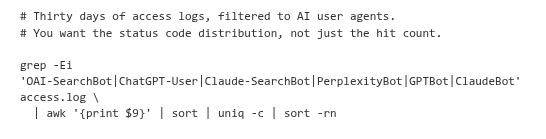
Four failure signatures show up repeatedly, and none of them are visible from the front end:
- 403s from the CDN. Bot-mitigation rules at Cloudflare, Akamai, or Fastly classify unfamiliar agents as scrapers. The page is public to a human and forbidden to a bot.
- An inherited `robots.txt`. Ported from the old platform, disallowing paths that no longer exist and agents nobody re-evaluated.
- Redirect chains and unstable URL paths. Long or unnecessary redirect chains add latency, consume crawl resources, and make canonical URL handling less predictable. They are worth removing, but there is no universal rule that a retrieval system will abandon a page after one or two hops.
- Rendering dependence. If important content exists only after substantial client-side JavaScript executes, some crawlers and retrieval systems may receive incomplete HTML or fail to process the page as reliably as a browser. Server-side rendering, static generation, or another architecture that exposes critical content directly in the initial response reduces that dependency.
Infrastructure changes introduce all four, not content changes. Which raises a timing problem.
A CMS migration is when this breaks
Replatforming changes all four variables at once. robots.txt gets ported over. CDN rules get rewritten and usually tightened. URLs move, so redirects appear. Rendering often shifts to a JavaScript framework.
Standard migration QA usually focuses on human and traditional search behavior: redirects resolve, forms submit, analytics fire, pages render correctly, and critical SEO signals survive the move. AI crawler access is not yet consistently part of that checklist. That creates a new migration risk: a site can launch successfully for users and conventional search while changes to robots.txt, CDN policies, rendering, or URL handling reduce its visibility to particular AI search systems. The problem may sit unnoticed until citation or referral reporting eventually exposes it.
If you replatformed in the last year, run the log check before buying anything else.
What we tell clients: this belongs in launch QA, beside the redirect map and the analytics validation. An afternoon of log analysis now, against a quarter of misdiagnosed content work later.
Layer 2: Appearance — Citation Rate, Done Honestly
Once eligibility is confirmed, you can measure whether you appear. This is where the tooling market lives, and where the methodology is weakest.
Citation rate = (tracked queries where your URL was cited ÷ total queries tested) × 100
The formula is fine. The trouble starts when teams run it once and report the output as a fact.
The number is a distribution, not a measurement
Language-model answers and their source sets are not perfectly repeatable. The same question can produce different citations across repeated runs because the generation, retrieval, ranking, indexing, and serving systems behind the answer are dynamic. Even ostensibly deterministic model settings do not guarantee identical production output. That means a single prompt run should never be treated as a stable market measurement.
So a citation rate from twenty prompts run once is noise wearing the costume of a metric. Report 15% in April and 22% in May and you may have measured an improvement, or you may have measured the weather.
Three habits make the number more defensible. Run every prompt repeatedly rather than once; five runs is a practical starting point for an internal benchmark, not a statistical law. Report the mean or citation frequency alongside the sample size and observed spread. “18% across 40 prompts × 5 runs” tells the reader something about the evidence; “18%” does not. And keep the core prompt set constant between reporting periods so changes in the score are not simply changes in the test.
Own your prompt set
Tracking tools ship default prompt libraries. Reasonable start, poor endpoint: they track the category rather than your buyers. Build the set from what your buyers actually ask, mined from discovery-call notes, support tickets, and site search logs. For an enterprise CMS buyer that means “which agency handles Sitecore to Contentful migrations at enterprise scale,” not “best CMS.” Thirty to fifty real buyer questions beat two hundred generic ones.
One more split to respect: being named in an answer and being linked as a source are different outcomes with different value. Perplexity cites with links consistently; ChatGPT often names a brand without linking it. Track them as separate columns or you will average two unlike things into a number that means nothing.
Score the portrayal, not just the presence
This is the column most teams never add, and the one that maps to rung three. For every response where you appear, record two things beyond the citation: whether the description is accurate, and which source the model used.
Accuracy is a three-way call, not a rating. Correct, incomplete, or wrong, scored against the claims you would actually make about yourself.
Source attribution is the more useful field. If the model described your platform coverage from a competitor’s comparison page or a 2023 review site, you have found the specific gap in your own content, and the fix is a page rather than a campaign.
What Google now gives you, and what it withholds
It is useful and sharply limited. The report currently includes no clicks, no click-through rate, no query data, and no average position, and it rolled out to a subset of properties rather than everyone at once.
It is useful and sharply limited. The report currently includes no clicks, no click-through rate, no query data, and no average position, and it rolled out to a subset of properties rather than everyone at once.
Read that limitation carefully, because it settles an argument you will have with a vendor. You can see that you appeared. You cannot see what was asked, whether anyone clicked, or which passage was used. Anyone demonstrating a clean closed-loop AI attribution dashboard is showing you a model, not a measurement.
One wrinkle: property-level and page-level impressions are aggregated differently. If multiple URLs from your site appear in one generative response, the property chart may record one site impression while the page table can credit the individual URLs separately. Do not expect the page rows to sum exactly to the property total. That is an aggregation difference, not a reporting bug.
Layer 3: Traffic — Make the Channel Visible
Without a dedicated classification, visits from ChatGPT, Perplexity, Claude, Copilot, and similar assistants are commonly absorbed into broader sources or channel groupings such as Referral, Organic Search, or Unassigned depending on the referrer and your GA4 configuration. The fastest-growing high-intent channel most B2B companies have sits in a bucket nobody opens.
Fix it with a custom channel group: Admin → Data display → Channel groups, new group named AI Search, condition on session source:
chatgpt\.com|chat\.openai\.com|perplexity\.ai|claude\.ai|gemini\.google\.com|copilot\.microsoft\.comThen move the AI Search channel above Referral in the list. GA4 evaluates rules top-down, so leaving it below means the traffic stays classified as Referral and your new channel stays empty.
Small numbers, large value
Expect the volume to look disappointing, and do not let that be the conclusion. The most-cited benchmark comes from Ahrefs, which analyzed its own traffic in June 2025 and found AI search drove roughly 0.5% of visits but 12.1% of signups, converting at about 23 times the rate of an average visitor.
Two caveats belong beside that figure. It is one company’s first-party data, not an industry study, and that company sells SEO software to an audience unusually likely to be experimenting with AI search. Close to a best case. Use it to argue AI traffic deserves segmentation, not to forecast your own conversion rate.
The structural point survives the caveats. Someone arriving from an AI answer has already had their question answered and their options narrowed. Judge that channel on volume alone and you will underfund it.
Layer 4: Pipeline — Be Honest About the Ceiling
This is where measurement frameworks overpromise, so here is the plain version. What follows is a limit, not a technique: no method is being withheld.
You can attribute AI-referred sessions with the same last-touch mechanics you use for any channel: pass the GA4 channel into your CRM, tag the lead source, report on it.
What you cannot do is attribute the influence of a citation that produced no click. ChatGPT names your company, the buyer types your brand into Google two days later, and it lands as direct or branded organic. The citation did the work and something else takes the credit. The best instrument for that gap is a “how did you first hear about us” field on your demo form, asked again on discovery calls. Imprecise, and currently the only thing that sees a citation that never became a click.
Do not build a board slide implying more precision than the data supports. A CFO who finds out a confident revenue number was modeled will discount everything else on the page.
What All Four Layers Have in Common
The common thread across the four layers is that AEO is not a copywriting exercise alone. Some problems are technical: crawler access, rendering, redirects, and delivery. Others are structural: whether a product claim exists as a governed field or has been manually rewritten across four hundred pages. And others are editorial: whether the underlying answer is accurate, useful, differentiated, and clear enough to deserve retrieval in the first place. At enterprise scale, the advantage comes from connecting all three content, structure, and delivery rather than trying to optimize pages individually after they publish.
Which returns us to rung three. A well-designed structured content model can create something a dashboard cannot: a governed source of truth for important entities and claims. Instead of rewriting the same product capability, statistic, or positioning statement independently across hundreds of pages, a headless CMS can model it once and reuse it consistently across web experiences and other channels. That does not guarantee an AI citation, but it reduces ambiguity, makes updates easier to propagate, and gives an AEO program a much cleaner unit to test, govern, and improve.
Qlik offers a useful example. Working with eight25, the global analytics company moved thousands of pages from Sitecore XP to Contentful on an accelerated enterprise timeline. Contentful’s public case study describes the migration as taking under five months and reports that page work that could previously take an hour or more could be reduced to roughly five minutes, including QA. The architectural lesson is not that headless automatically improves AI visibility. It is that the same structured, reusable content model that speeds publishing also gives an AEO program cleaner, more consistent information to expose across pages and channels.
What to Actually Put in Front of Your CEO
One slide. Four lines. Each with its confidence level stated.
- Eligibility: “Retrieval crawlers successfully fetched [X]% of our priority pages over the last 30 days.” (Fact.)
- Appearance: “We were cited in [X]% of responses across [N] buyer questions, run [K] times each, ranging [low–high].” (Sampled estimate.)
- Traffic: “AI-referred sessions were [N] last month, converting at [X]% versus [Y]% site-wide.” (Measured.)
- Pipeline: “[N] opportunities self-reported an AI assistant as first touch.” (Self-reported, directional.)
Labeling the confidence is not hedging. It is what makes the slide survive its second reading, and the difference between a marketing report and an operating metric. If layer one is red, do not present layers two through four. Present layer one and the fix.
Frequently Asked Questions
How do I know if AI is citing my website?
Check three things in order. Confirm retrieval crawlers such as OAI-SearchBot, PerplexityBot, and Claude-SearchBot get 200 responses in your server logs, because a blocked crawler cannot cite you. Test real buyer questions across ChatGPT, Perplexity, and Gemini, running each several times and recording how often you appear and whether the description is accurate. Then segment AI referral traffic in GA4 with a custom channel group.
What is a good AI citation rate?
There is no reliable benchmark, and any vendor quoting one owes you their methodology. Citation rate depends entirely on the prompt set, and a set weighted toward branded questions produces a high number that means little. Measure your own baseline across a fixed set of real buyer questions and track the direction. Track portrayal accuracy alongside it, because a rising citation rate with a rising wrong-portrayal count is not progress.
Does Google Search Console show AI Overviews data?
Yes. Since June 3, 2026, dedicated Generative AI performance reports cover AI Overviews and AI Mode, showing impressions by page, country, device, and date. They do not include clicks, click-through rate, query data, or average position, so they confirm you appeared without showing what was asked or whether anyone followed the link.
Should I block AI crawlers in robots.txt?
Only after separating the different jobs those agents perform. GPTBot and ClaudeBot are associated with potential model-training use. OAI-SearchBot and Claude-SearchBot support AI search visibility, while ChatGPT-User and Claude-User can be involved in user-triggered retrieval. PerplexityBot crawls content for Perplexity’s search index. Google-Extended is different again: it is a robots.txt control token rather than a standalone crawler and governs certain uses of Google-crawled content for Gemini. Blocking training access can be a defensible policy; accidentally blocking search or retrieval access can reduce your ability to appear from your own content. Make the decision agent by agent rather than using a blanket rule.
Why did our AI visibility drop after a website migration?
Replatforming can change several AI-relevant conditions at once: robots.txt rules may carry over from the old platform, CDN bot policies may change, URL migrations can introduce unnecessary redirects, and a new JavaScript-heavy frontend may expose less content in the initial HTML. None of those automatically causes an AI-visibility drop, but together they create enough new variables that crawler and rendering checks should now be part of migration QA.
Start With the Log File
The sequence matters more than the tooling. Confirm eligibility, measure appearance with stated sample sizes and a portrayal column, make the traffic channel visible, then report pipeline with its uncertainty labeled.
Most teams start at layer two because that is what the market sells. If your retrieval crawlers are getting 403s, every hour spent optimizing content for citations goes into a page that cannot be cited.
eight25 is an enterprise digital agency with deep experience in headless and composable platforms, including recognized partnerships with Contentful and Contentstack. We treat AEO as an architecture and operations problem as much as a visibility problem: structured content models, crawl-aware delivery, reusable entities, and migration QA that tests whether the systems increasingly mediating buyer research can actually access and interpret the content. The objective is not to build a site “for bots.” It is to build one content foundation that can serve both of the audiences enterprise websites now have.